
Why voice AI matters now
Voice-driven commerce and conversation have moved from novelty to necessity.
A March 2026 report by Roots Analysis values the global voice commerce market at USD 72.8 billion in 2026 and projects it to grow to USD 923.83 billion by 2040, reflecting a compound annual growth rate of about 19.90%.
Survey work by PwC and Statista, cited in Omnia Retail’s voice-search study, shows that 71% of people prefer voice search over typing, and that 35% of U.S. consumers own a smart speaker.
Voice assistance has become part of everyday life.

The broader artificial-intelligence boom is transforming retail as well. A recent survey compiled by Capital One in 2026 found that 69% of consumers have used AI for online shopping, and that 63% want generative AI to help them shop.
Retail adoption is following consumer demand: 97% of retailers have already implemented artificial intelligence or have an AI program in development.
In contact-center applications, a 2025 voice AI report highlighted that contact centers saw a 35% reduction in call handling time and a 30% increase in customer satisfaction after deploying a voice-AI solution.
These figures illustrate why retailers are investing in conversational technologies: they cut operational costs, improve customer service and align with shoppers’ expectations.
How NaviPartner stands out
NaviPartner has a long history of delivering unified commerce solutions built around Microsoft Dynamics 365 Business Central. Over the past year we have been exploring how to extend our retail and hospitality platforms with voice and generative AI. What sets us apart is the way we combine three elements:
- Deep integration with core systems. Our solutions are not just chat widgets layered on top of a website. They tap directly into Business Central to read and write real data – orders, inventory, sales and financials – ensuring that every conversation has a real impact on operations.
- Understanding of retail workflows. As a Microsoft partner focused on commerce, we know the pain points of quick-service restaurants, specialty retailers and omnichannel merchants. Our AI initiatives target those pain points, such as order taking, product discovery and analytics, but the same architecture can be extended to any process where natural language interfaces meet retail and hospitality data.
- Human-centric design. Voice and generative AI should assist, not replace, people. Our prototypes emphasize natural interactions, multi-language support and security so that both staff and customers feel comfortable using them.
Our new AI-powered experiences
We are developing three complementary modules that illustrate how artificial intelligence can deliver practical value to retailers and hospitality operators. Each module can work on its own or as part of a unified voice experience.
These modules are examples of what is possible, and the platform is designed to be flexible, so we can develop additional conversational tools based on the unique challenges of each client.
1. Voice ordering assistant
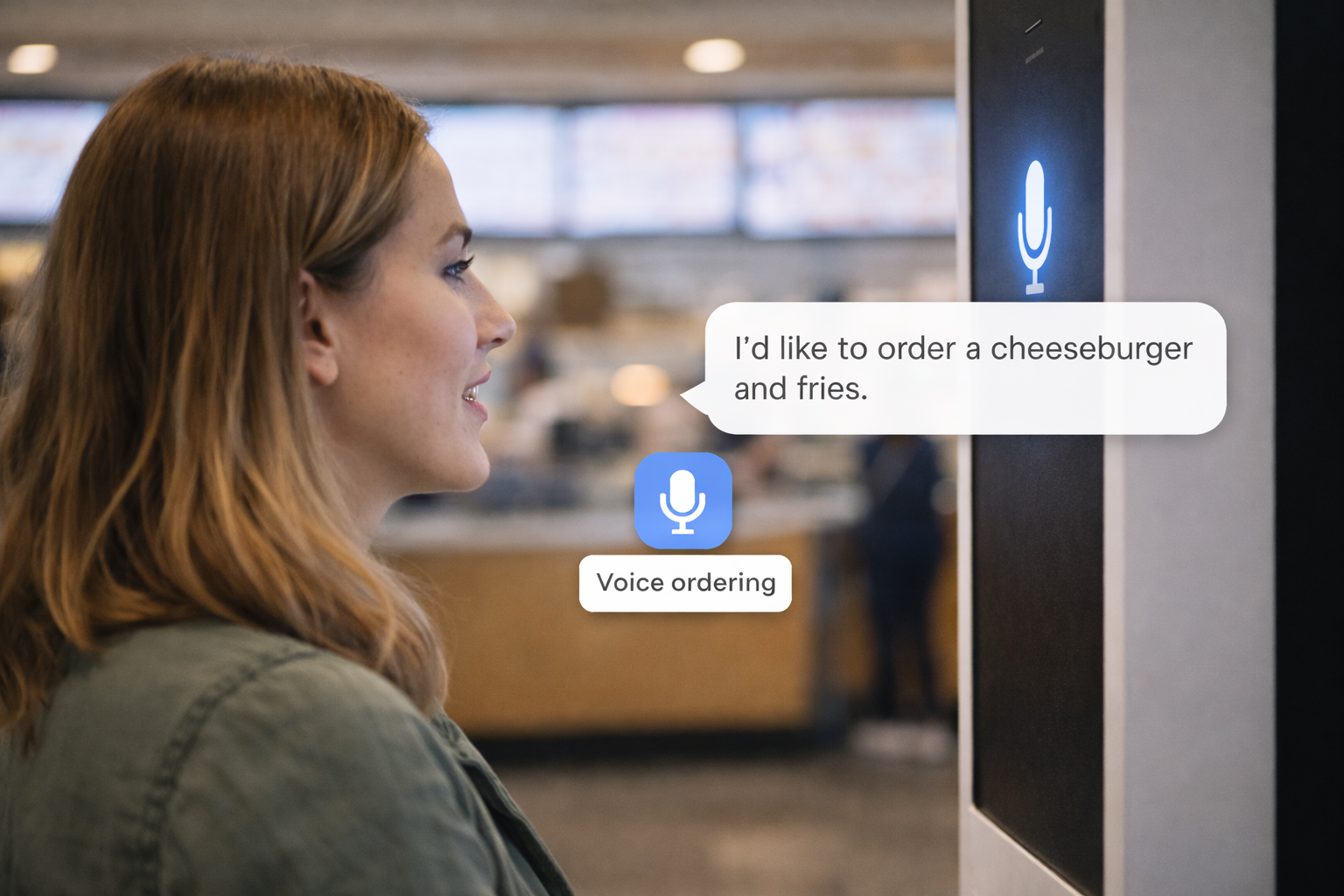
This assistant lets guests order meals or products verbally through a kiosk, app or smart speaker. It guides customers through the menu, confirms selections, processes modifiers and upsells items.
Because it writes directly into Business Central, every order updates sales and inventory records in real time. Voice ordering addresses staffing challenges and queue bottlenecks at quick-service restaurants.
Industry research shows that modern voice ordering integrated into point-of-sale and loyalty systems reduces misheard orders and enhances upselling. Our solution is designed to support multiple languages and adapt to regional menus.
2. Conversational analytics agent
Managers often struggle to unlock insights from their ERP without technical support. Our analytics agent connects Business Central tables to a cloud analytics database and enables users to ask questions like “what were our top selling items last month?” or “how is profit trending by region?” using natural language.
Rather than writing SQL, users receive dashboards generated automatically and presented in clean, branded themes. Such natural-language analytics has been proven to democratize data access. It empowers decision makers to explore trends and take action without waiting for a specialist.
The agent can operate in voice mode for quick snapshots or text mode for richer visualizations and saved dashboards.

3. Product search and discovery
In ecommerce, product discovery often starts with a keyword search. Our voice search assistant allows shoppers to say “find running shoes under fifty euros” or “show me red dresses in medium.”
The assistant queries the catalogue, returns relevant results and can even suggest complementary items based on purchase history.
Voice search aligns with research showing that a large share of consumers prefer to use voice over typing for product discovery.
By surfacing the right items quickly, retailers can boost conversion rates and create a frictionless shopping experience.

What this means for our clients
For merchants and hospitality operators, the transition to voice AI is not just a technological upgrade, it is a shift in how they interact with customers and manage operations. The benefits are tangible:
- Speed and convenience: Voice ordering reduces queue times and ensures that orders are captured accurately. Shoppers and diners can multitask while placing orders, and staff can focus on preparation rather than transcription.
- Better decisions: Conversational analytics empowers managers to ask questions and get immediate answers. This leads to faster decisions on stock levels, pricing and promotions, without waiting days for reports.
- Personalization: AI-driven product search learns from past purchases and browsing behaviour to suggest relevant items, supporting upselling and cross-selling. Research indicates that personalized recommendations can lift revenue by up to 40%.
- Cost reduction: Case studies like IBM’s telecom example demonstrate that voice AI can lower call handling times by over a third and boost customer satisfaction. When applied to ordering and support, those efficiencies translate into lower staffing costs and higher throughput.
- Future readiness: With nearly every major retailer investing in AI and consumer adoption rising, embracing voice and generative AI positions our clients at the forefront of industry innovation. It ensures they remain relevant as consumer expectations evolve.
Looking ahead
Voice and generative AI are no longer science fiction; they are tools that deliver real results today. At NaviPartner our goal is to embed these technologies at the heart of retail and hospitality workflows and to evolve alongside our clients’ needs.
We will continue to explore new voice and generative AI scenarios beyond our current prototypes, working together on solutions for any part of the customer journey or back office workflow.
If you are interested in exploring our AI capabilities or want to discuss how conversational experiences could support your business, please get in touch. We believe the future of commerce is conversational – let’s build it together.